
Reclaim Health
America: The Country That Never Sleeps
Published on
August 28, 2026
By
Kyrie Rogers

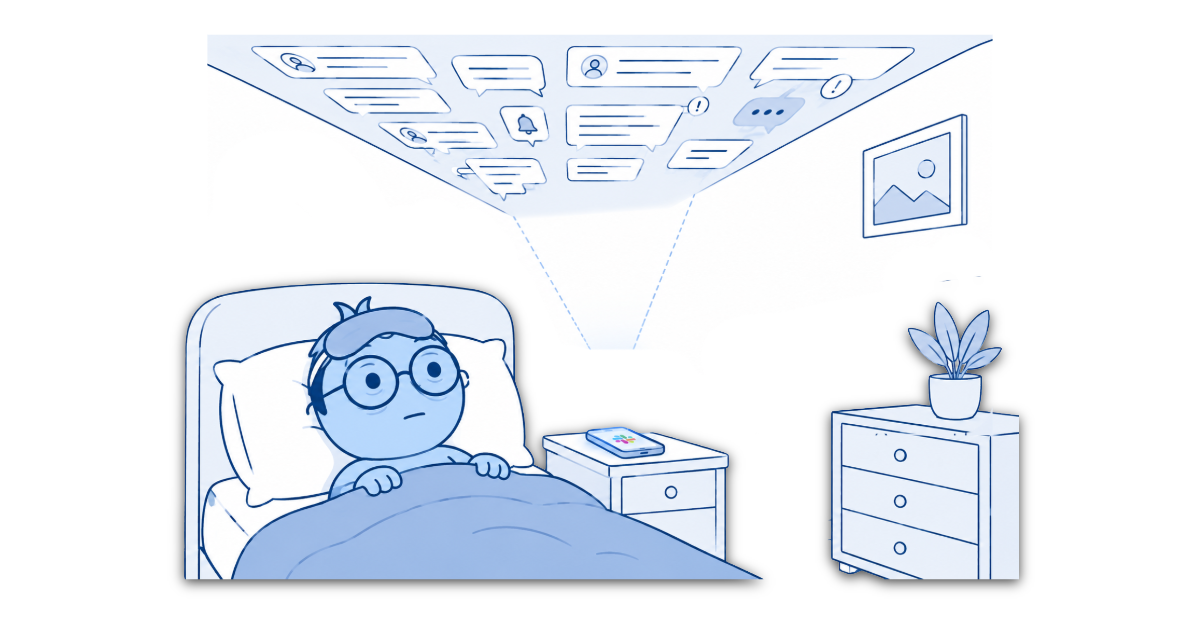
Everyone notices four mattress stores sitting idle in one strip mall. Lights on, a hundred beds inside, nobody lying on any of them. The same three chains in every strip mall in America, all selling mattresses. Maybe the only explanation is money laundering. Lol.
Americans spent $28.4 billion at bed and mattress stores last year, across 15,261 businesses.1 The numbers are a tell: the country can’t sleep and is shopping for it.
And it isn’t working. 6 in 10 US adults still don’t get the recommended amount of sleep.2 We are the best-equipped insomniacs in human history. Cooling gel, weighted blankets, mouth tape, magnesium, Lemme Sleep gummies all over your feed, a hybrid king with a 100-night trial and financing. All of it aimed at the surface of the problem.
65% of American adults have lost sleep over work. Among adults under 45, it’s 76%.3
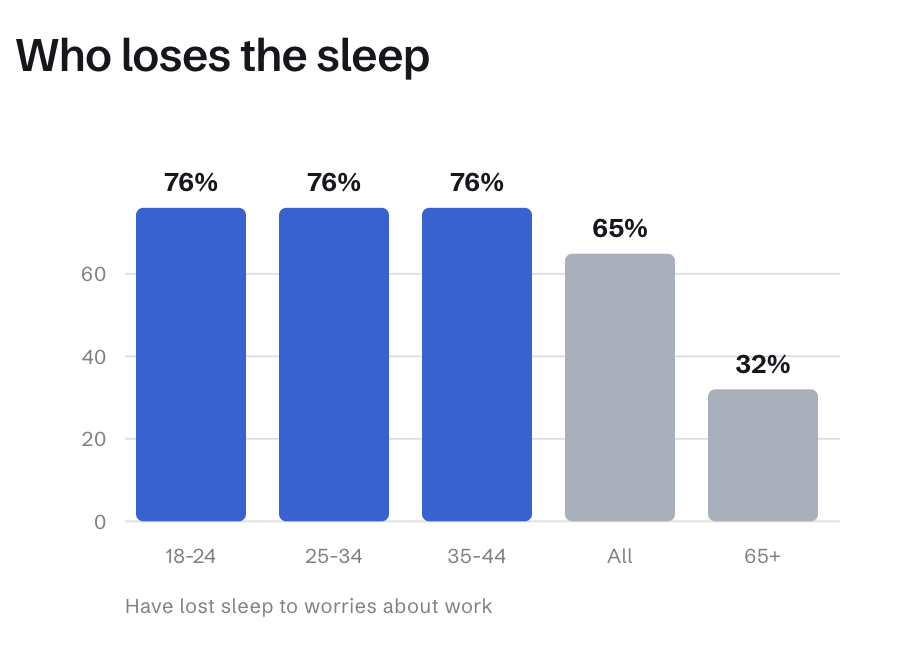
Three out of four working-age people in this country have laid awake over a job. Over the pile of coordination that never fit into the day: the update they forgot to send, the thread they never saw, the deck someone needs by 9am, the meeting that will exist tomorrow only because nobody could tell what happened today.
Sleep got traded for caffeine, and you can watch the trade happen by decade. The 80s and 90s sold us the bed. Adjustable air chambers, memory foam borrowed from a NASA lab, a mattress you could dial in like a thermostat. When the bed didn’t fix it, the 2000s sold the opposite: if you can’t fix the night, caffeinate the day. Starbucks put a green sign on every corner and coffee stopped being a treat and became infrastructure. In 2004, 49% of American adults drank coffee daily. Now it’s 66%, at three cups a head.4 And 56% of adults say they use caffeine specifically to push through sleepiness, with 46% napping to manage it.5 That’s most of the country running maintenance on a deficit.
Lunch got traded for whatever premade thing eats cleanly at a desk. The Trader Joe’s container, the protein bar, the salad kit engineered for one hand and a laptop. Only 35% of workers take a lunch break away from their desk every day, and 63% eat their midday meal during a meeting.6 There’s an entire aisle built for people who don’t get a lunch break.
The evening got traded for a screen. Just 17% of adults put their devices away an hour before bed.2 The other 83% are still technically at work at 11pm, and most of them would tell you they’re relaxing.
None of these are personal failures. They’re load-bearing infrastructure for a day that no longer fits inside a day.
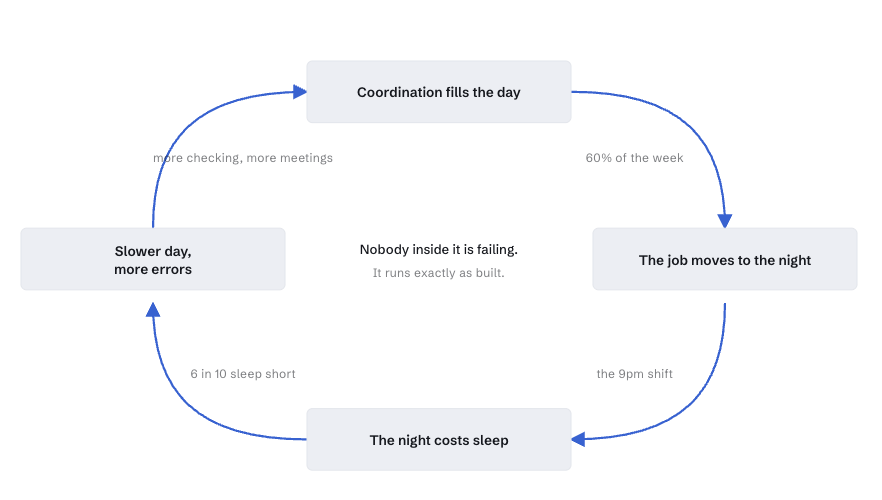
About 60% of the workweek now goes to work about work, leaving 40% for the thing you were hired to do.7 Microsoft’s own research puts 57% of the day into communicating and 43% into creating.8
So the daylight fills up with coordination. Status, syncing, searching, chasing, confirming. And the actual job, the part that requires a functioning brain, gets pushed into the only unclaimed hours left. Which are the hours your body was already using.
Night work isn’t dedication. It’s a day that didn’t fit, showing up on your couch at 9pm.
The World Health Organization and the ILO estimate that long working hours, 55 or more a week, are tied to 745,000 deaths a year from stroke and ischemic heart disease. Against a standard 35 to 40 hour week, that’s a 35% higher risk of stroke and a 17% higher risk of dying from heart disease.9
The WHO’s cancer agency classifies night shift work as probably carcinogenic to humans, Group 2A.10 Read that again with your own calendar in mind. The night shift is a listed occupational hazard. Millions of people are working one every Tuesday at 11pm, and none of them got the hazard pay or the warning.
And a 2025 meta-analysis of 76 longitudinal cohort studies found short sleep associated with a 27% higher relative risk of cognitive decline, and poor sleep quality with a 24% higher relative risk of Alzheimer’s.11
42% of adults say sleepiness already cuts into their work productivity.5
Follow that: coordination eats the day, the real work moves to the night, and the night costs sleep, so the unslept person is slower and makes more errors, which generates more clarifying, more checking, more meetings about what happened, which eats more of the day, which pushes more real work into the night.
What a coordination layer has to do with your health
A coordination layer is the connective software that keeps tools, people, and decisions in sync without anyone chasing status, so the work moves without a person carrying it between systems by hand. That’s the role Chambiar plays, and it’s the difference between day and night.
The Chambiar team has built the product around a single focus: give people their hours back. If you want to see what the team is building, it’s here: chambiar.ai.
Healthier people, healthier company.
This is the part that usually gets split into two conversations, and it shouldn’t be.
When a person gets their hours back, they sleep. The habits work handed them stop being necessary, which is the only way habits like that ever actually go away.
When a company gives those hours back, it gets the compound version. Fewer errors from tired people. Fewer decisions delayed past the point where they were worth money. Fewer good operators quietly burning out and leaving with everything they knew. Capacity that was always on the payroll and never reached the work.
So the honest question isn’t whether you’re sleeping enough. It’s where the hours went, and whether any of them were ever yours. That’s what the Work Receipt shows you. Free, two minutes, your own number.
Reclaim Capacity means the workday ends where it’s supposed to, and the night stops being overflow storage for a broken system. You shouldn’t have to spend your health subsidizing software that won’t coordinate itself.
Early access is open at chambiar.ai/betasignup.
Sources
1 IBISWorld, “Bed & Mattress Stores in the US,” 2025. ibisworld.com
2 National Sleep Foundation, “2025 Sleep in America Poll,” March 2025. thensf.org
3 American Academy of Sleep Medicine, “Sleep Prioritization Survey 2025: Losing Sleep to Worries,” August 2025. aasm.org
4 National Coffee Association, “National Coffee Data Trends,” Spring 2025, and “Daily coffee consumption at 20-year high,” 2024. ncausa.org
5 American Academy of Sleep Medicine, “Daytime sleepiness affects daily activities of most adults,” 2025. aasm.org
6 ezCater, “2025 Lunch Report,” 2025. ezcater.com
7 Asana, “Anatomy of Work,” via Worklytics, “2025 Productivity Benchmarks,” 2025. worklytics.co
8 Microsoft, “Work Trend Index.” microsoft.com
9 World Health Organization and ILO, “Long working hours increasing deaths from heart disease and stroke,” May 17, 2021. who.int
10 IARC Monographs, “Volume 124: Night Shift Work,” Group 2A. iarc.who.int
11 Journal of Neurology, “Sleep disorders and the risk of cognitive decline or dementia: an updated systematic review and meta-analysis of longitudinal studies,” October 13, 2025. link.springer.com