
Founder Voice
It's Not Dysfunction Keeping You Down.
Published on
June 16, 2026
By
Kyrie Rogers

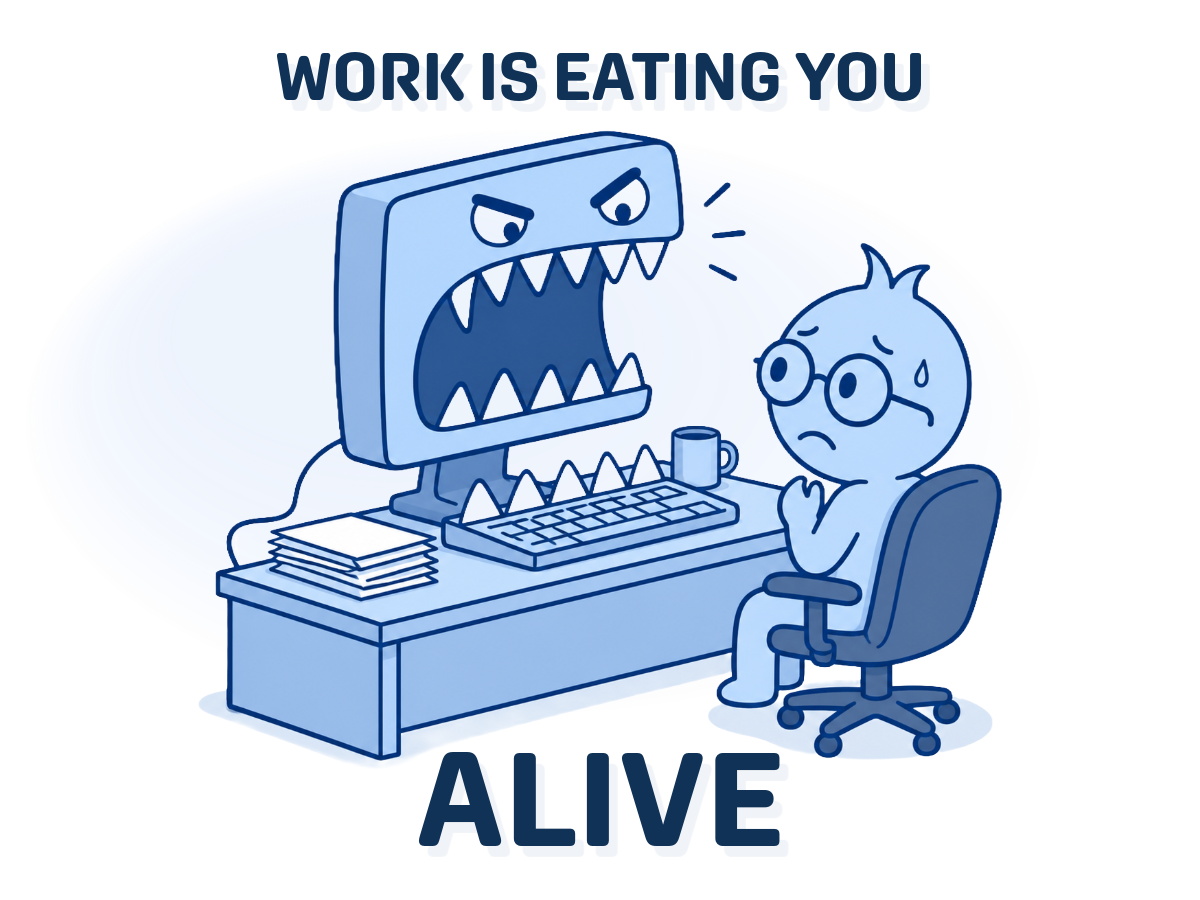
It's design.
You medicate to focus. You caffeinate to function. You open one tab, forget why, and open three more chasing the reason. Then you end the day wrung out and decide something is wrong with you.
Nothing is wrong with you. Something is wrong with the work.
We have spent a decade treating that as a personal failing. The whole productivity industry runs on it: your focus, your willpower, your morning routine. So we keep buying the planner, the app, the supplement, and feeling like frauds when none of it sticks.
Look at the numbers and a different story shows up. The CDC now counts roughly 15.5 million US adults with an ADHD diagnosis. One large 2025 analysis found stimulant prescriptions climbed 157% in under a decade, with the steepest rise after 2020, the same stretch when work scattered into a dozen disconnected screens. Coffee is quietly losing the youngest workers to energy drinks. And depending on which 2025 survey you read, somewhere between two thirds and four fifths of employees say they are burned out.
That is not a generation that suddenly got weaker. That is a generation responding, rationally, to conditions that are genuinely hard to function in.
To be clear, this is not a claim that ADHD is not real. It is real, and treatment changes lives. The point is narrower and more uncomfortable. When so many of us, diagnosed or not, spend the day feeling scattered, wired, and behind, it is worth asking what in the environment is manufacturing that feeling at scale.
So look at the environment. Microsoft studied 31,000 workers in 2025 and found people get interrupted during core hours about every two minutes, up to 275 times a day. Your work does not live in one place anymore. It lives in your inbox, three chat apps, a project tool, a doc somewhere, and a meeting that should have been a message. You are not doing the work. You are the human glue holding all of it together, every hour, and then wondering why you are wrung out by 2 p.m.
Your brain is doing the coordinating that the software should be doing. Of course, it is fried.
So the next time you reach for the third coffee, or feel like a failure for losing the thread again, try a different thought. Maybe it was never your discipline. Maybe no human was built to manually sync ten systems all day and stay calm doing it. This is a wellbeing problem before it is a productivity problem. The cost is not only lost hours. It is your nervous system, your evenings, and the version of you your people get once the workday finally lets go.
on
Another wellness perk will not fix this. Neither will a stricter routine or a better planner. You cannot self-optimize your way out of a system that is structurally working against you. The thing that has to change is the system, the way work is connected, so the coordinating stops landing on a person.
That is the whole reason we are building Chambiar, a coordination layer that does the syncing so you do not have to. You do not need us to start, though. You can see the cost you are carrying right now. The free Work Receipt shows where your week actually goes in about two minutes: see your own number. Most people are quietly shocked by how little is left for the work that matters.
You are not the problem. You never were.
If you want more writing that says the quiet part out loud, subscribe to the Chambiar Substack so you do not miss the next one.
P.S. Tip of the week: run your Work Receipt and look at one number, the hours left for focused work after the coordinating is subtracted. If that number makes you wince, that is the system talking, not you.