
Murder in the Workplace

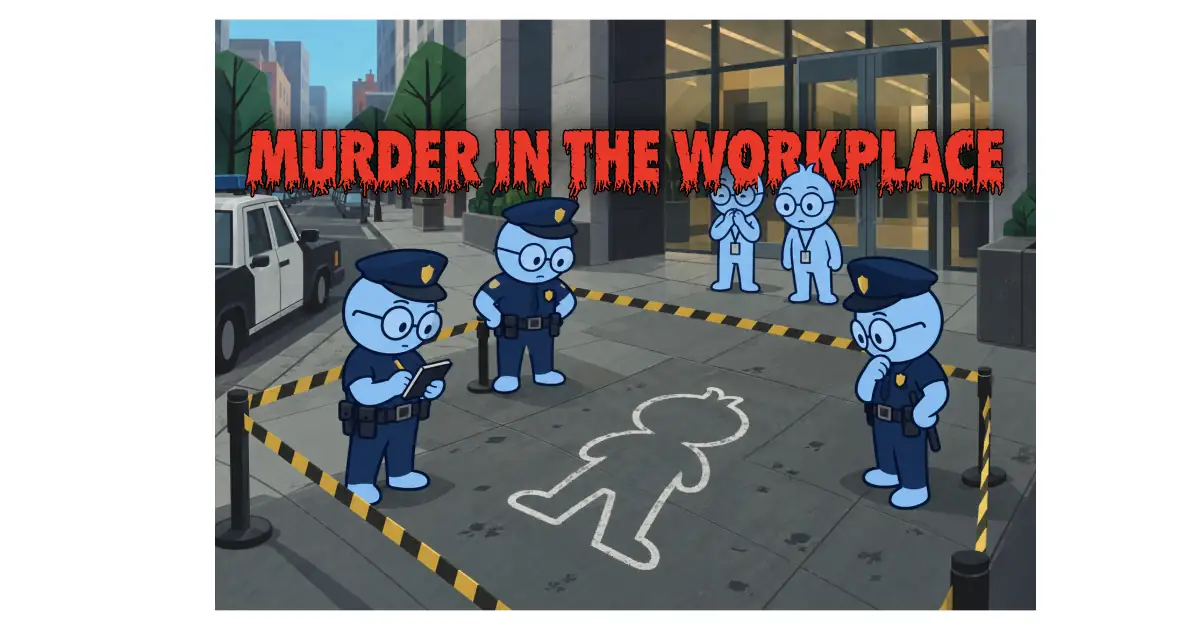
The victim is motivation. It was found Monday morning, slumped over a laptop with fourteen tabs open, still logged in.
This didn't happen overnight. Gallup has been watching the scene for years, and the file reads like a coroner's report. In 2023, 23% of workers worldwide were engaged, meaning they cared about the work and would go the extra step for it. In 2024 it was 21%. In 2025 it was 20%.1, 2 Put plainly, four out of five people at work right now are going through the motions. They show up, they log in, and they leave the part of themselves that does great work at home.
That has a price. Gallup put the cost of the 2024 drop alone at $438 billion in lost productivity.1 Not the cost of disengagement overall, just the cost of a two-point slide. That's what it costs when a few more people stop caring.

So who did it?
Every good whodunit starts the same way. Lock the doors, gather the suspects in the library, and go one by one.
Suspect #1: The Meeting
The Meeting has no alibi. It was everywhere.
Microsoft studied how knowledge workers actually spend their day and found they're interrupted every two minutes, by a meeting, an email or a chat ping. That's 275 times a day.3 Think about what that does to anyone trying to think. You can't write, plan or solve anything hard in two-minute pieces. You just react, all day, and go home feeling busy and empty at the same time.
The Meeting has also been working late. 57% of meetings are now unscheduled calls with no calendar invite, and meetings after 8 p.m. are up 16% in a year.3 It doesn't book time anymore, it just shows up.
Suspect #2: The Eleventh Tool
The Eleventh Tool arrived promising to help. They always do.
Even smaller companies now run about 152 apps, and software spend has climbed to $4,830 per employee, up 22% in a single year.4 Every one of those tools was bought to save time. Together, they created a job nobody applied for: carrying information between them. Copy it here, update it there, check three places to find out if anything changed.
The evidence gets worse when you look at what sits untouched. Companies waste an average of $21 million a year on software licenses nobody uses.4 The tools aren't doing the work. People are doing the work of keeping the tools alive.
Suspect #3: The Update Nobody Read
Atlassian surveyed 12,000 knowledge workers and found teams spend a quarter of their week just looking for information.5 That's more than a full day, every week, spent hunting for the doc, the decision or the one person who knows. Half of workers said their team had unknowingly done the same work as another team.5 The work got done twice, and nobody could see it either time.
Then comes the detail that should end careers. Only 7% of executives know exactly how their teams' work supports company goals.5 Everyone is writing updates, and almost nobody at the top can connect them to anything. You can do the work, report the work, and still never find out if it mattered. That's how motivation dies. Not from too much work, but from work that disappears.

The witness
One person saw everything: the manager.
Managers live in the middle of all three suspects. They run the meetings, maintain the tools, and write the updates for the people above them. So it tracks that their engagement fell harder than anyone's, from 30% to 27% in a single year, with young managers and female managers falling furthest.1 By 2025, just 22% of managers were engaged.2 When the people responsible for keeping everyone else motivated are checking out, the crime spreads to the whole floor.
The reveal
Here's the twist every detective eventually lands on. They all did it.
The Meeting didn't act alone, and neither did The Eleventh Tool or The Update Nobody Read. They work as a crew, and they work because the system was built that way. Nearly half of employees, and more than half of leaders, say their work feels chaotic and fragmented.3 That isn't a personality problem. It's a design problem.
Which means nobody in this story is the killer. Not the employee who stopped going the extra mile, and not the manager running on fumes. People don't lose motivation because they stopped caring. They lose it because the system made their caring impossible to see.
What kills motivation at work?
Rarely the work itself. Motivation erodes when effort becomes invisible: constant interruptions, too many tools to keep in sync, and updates nobody connects to outcomes. Gallup found only 20% of employees worldwide were engaged in 2025. The fix is visibility, so work gets seen, credited and tied to what matters.
Reclaim Meaningful Work
A coordination layer is the connective software that keeps tools, people and decisions in sync, without a person carrying the work between systems by hand. That's the role Chambiar plays. The Chambiar team has built it to take the meetings about meetings, the tool upkeep and the status chasing off people's plates, so the work they were hired for gets their time back, and gets seen when it's done. See what the Chambiar team is building at chambiar.ai.
Every case starts with evidence. The Work Receipt takes two minutes and shows where your week actually goes, and what it costs. Free. Your own number.
Motivation isn't dead. It's buried under the work about work. Reclaim Meaningful Work means digging it out: fewer meetings, one place the work lives, and credit for the work that actually moves things forward.
Case closed.
Early access is open at chambiar.ai/betasignup.
This argument runs every week. Subscribe on Substack so you don't miss the next one.
Sources
1 Gallup, "State of the Global Workplace 2025," global press release, 2025. gallup.com
2 Gallup, "State of the Global Workplace 2026," 2026. gallup.com
3 Microsoft Work Trend Index, "Breaking down the infinite workday," Jun 17, 2025. news.microsoft.com
4 Zylo, "2025 SaaS Management Index," Jan 16, 2025. zylo.com
5 Atlassian, State of Teams 2025, via UNLEASH, Apr 28, 2025. unleash.ai