
AI & Work
The 40-Hour Lie
Published on
May 19, 2026
By
Kyrie Rogers

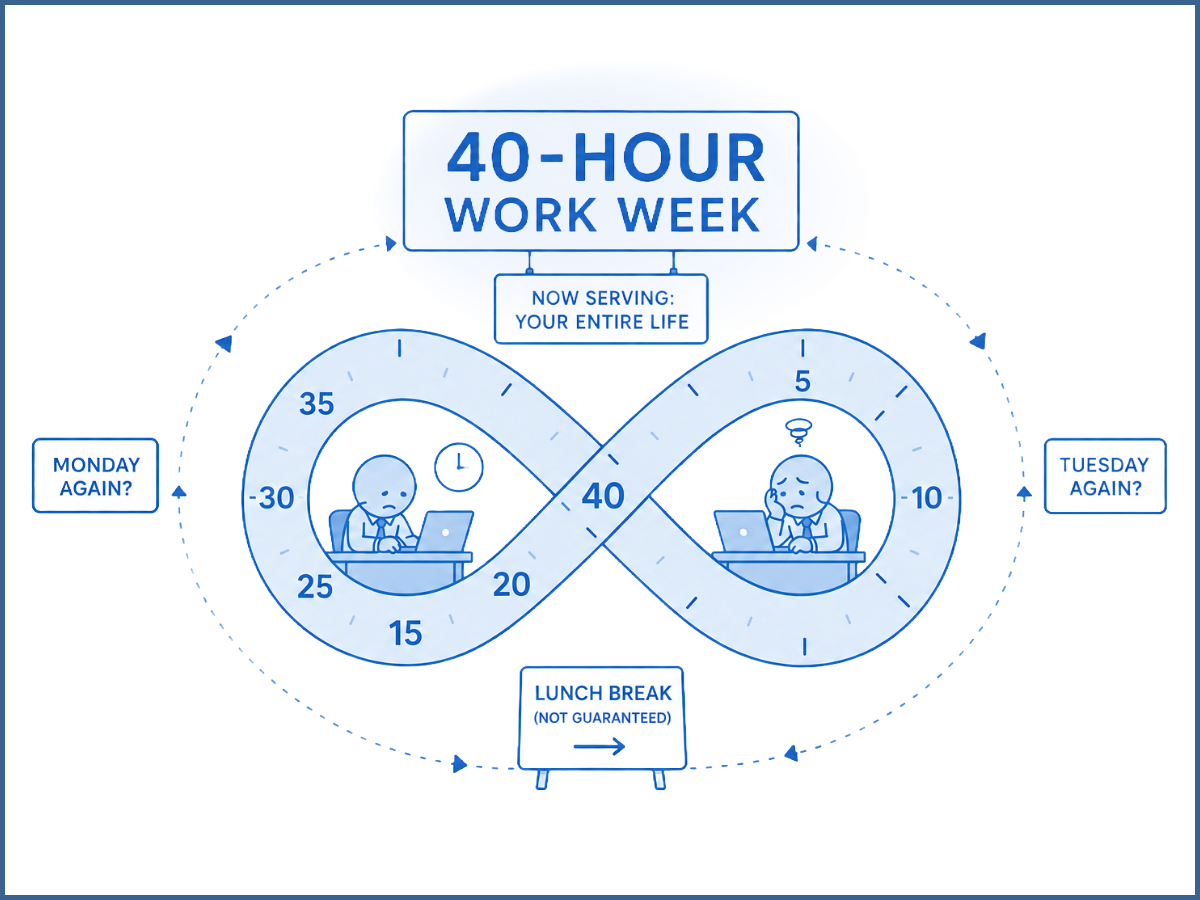
You don't have a productivity problem. You have a coordination racket.
You think you're paid to do work. You're not. You're paid to coordinate it.
Microsoft released their 2025 Work Trend Index, where they studied 31,000 workers and trillions of data points across Microsoft 365. The findings are not subtle.
The average knowledge worker is interrupted every two minutes. That's 275 times a day, between 117 emails and 153 Teams messages. 85% of those emails get read in under 15 seconds because nobody actually has time to engage with them. They're triaging. By 6 a.m., 40% of Microsoft 365 users are already in their inbox.
Meetings after 8 p.m. are up 16% year over year. 60% of meetings are unscheduled, and one in ten is booked at the last minute. PowerPoint edits spike 122% in the final ten minutes before a meeting starts, because everyone is doing the actual work in the time we used to call "preparation."
This is what Microsoft now calls the infinite workday. It used to be a metaphor. Now it's the data. And that isn't even the damning part.
The damning part comes from Asana. Their Anatomy of Work survey looked at over 10,000 knowledge workers and found that 60% of their day is spent on what they call work about work. Communicating about tasks. Looking for documents. Switching between apps. Chasing approvals. Updating someone who already saw the update in another channel. The average knowledge worker uses about eight apps every day. The director-level average is ten.
So here is the math, from real research, with real numbers:
- You work 40 hours.
- You spend 24 of them coordinating.
- You spend 5 of them on context switching.
- You spend the rest, maybe 11 hours if you are lucky, on the thing you were actually hired to do.
-
Eleven hours: that is your real workweek.
And the part nobody says out loud:
The companies selling you "productivity software" know this. They built their businesses on it. Slack does not exist to make work faster. Slack exists because email got too messy. Then Slack got too messy, so they sell you Slack Connect. Notion does not exist to organize your knowledge. Notion exists so you can spend Sunday night reorganizing the database that organizes your knowledge. Asana publishes the Anatomy of Work report every year. Every year the number gets worse. Every year their solution is more Asana.
None of these tools are bad. Most are very good at the one thing they do. The problem is that you don't have one thing. You have nine things. Nine apps. Nine sets of notifications. Nine places where the same conversation is happening in slightly different versions. And the labor of holding all nine together, in your head, in real time, is your real job.
Nobody is paying you for that job. Nobody put it on your job description. Nobody will mention it in your performance review. But it's the job.
When people say they want a four-day week, what they're saying is: if you take away the coordination tax, I can do the work in four days. They're right. They've been right for a decade. The problem isn't how many days you work. The problem is how many of those hours are actual work versus the work that exists only because your tools don't talk to each other.
Here is where it gets risky to say.
We don't have a productivity problem in this country. We have a coordination racket. The companies who sell you "work tools" are the same companies whose business model depends on you needing more of them. The more fragmented your work gets, the more software you buy. The more software you buy, the more fragmented your work gets. It's a loop. It just isn't yours.
Add AI to that and it gets worse. AI lets you do the coordination faster. It does not eliminate the coordination. You can now reply to 150 Teams messages in twenty minutes instead of forty. Congratulations. You're still spending 24 hours a week on work about work, you're just doing it more efficiently.
This is what the productivity industry will not tell you. Faster is not the answer. Different is the answer.
The 40-hour week is not a target. It's a relic from when work was measured by presence. We measure presence by the thing presence used to imply, which was output. But output and presence are not the same thing anymore. Most of the people who output the most are present the least. They are just not playing the visibility game.
So if you're reading this and your week feels chaotic and fragmented, here is the thing nobody else is going to tell you.
You're not bad at your job. You're extremely good at a job nobody hired you to do.
The system is fine with that, because the system isn't measuring it.
The Chambiar team has built a tool that does. Two minutes, no signup. It tells you, based on your week, where your 40 hours actually went.
We're not going to pretend the receipt fixes the system. It doesn't. But seeing the number is the first time most people realize the problem isn't them.
We publish more like this every week on Substack. Subscribe here →
Kyrie
CEO & Co-Founder, Chambiar AI